
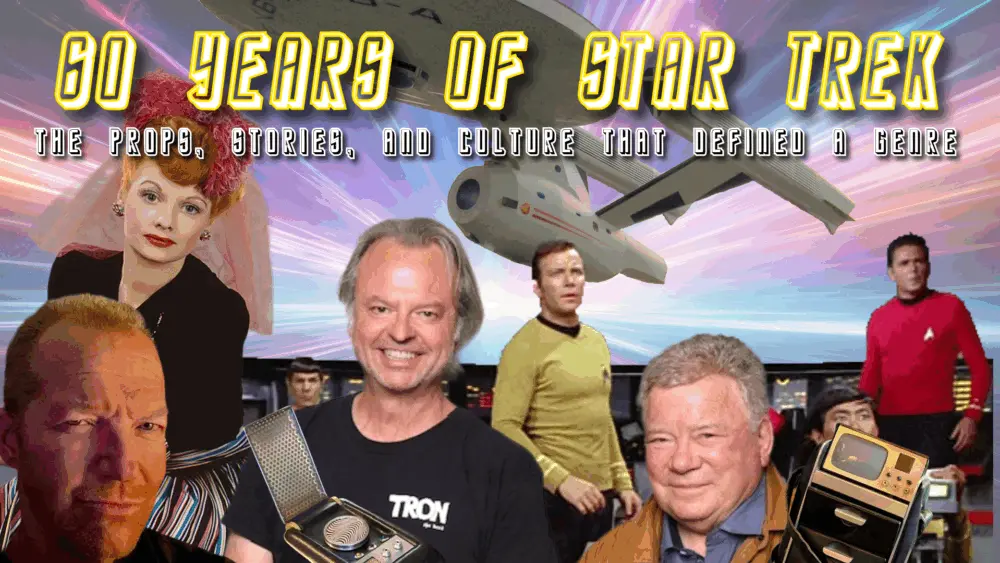
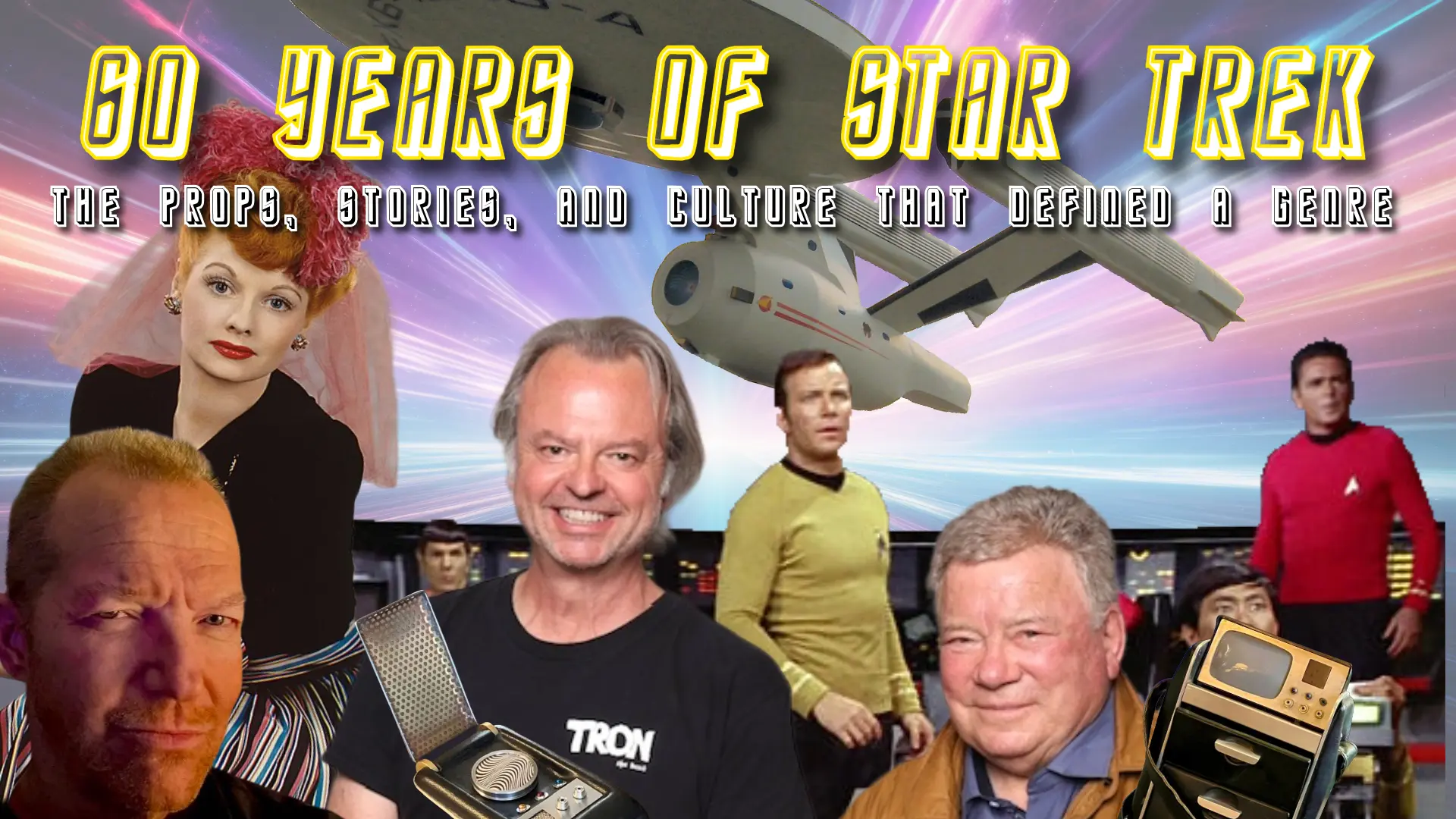
Happy 60th, Star Trek (and Tron)! Special Interviews air December 21st at 9:30AM & 4PM on Legends 95.3FM / 810AM

Next year, Star Trek: The Original Series turns 60 years old. That means it’s been six decades since the world first heard:
“Space, the final frontier…” and watched the crew of the Enterprise boldly go where no one had gone before.
For Legends Radio host Tron Simpson (who also turns 60 next year 👴🏼), the show isn’t just background nostalgia –
it’s part of his life’s soundtrack. From the uniforms and the starship to the strange new worlds and, yes, the props,
Star Trek grabbed kids and adults alike and never let go.
This special tribute pulls together some of that story: how Lucille Ball and Desilu Studios fought to get Star Trek on the air,
how visionary designers built the look of the future on a TV budget, and how prop makers like John Long helped turn childhood
cardboard toys into museum-worthy artifacts (and the actually insane way that he was able to enter the industry of prop production). And to top it off, William Shatner himself shares how he ended up in the captain’s chair.
Lucille Ball, Desilu, and the Show That Almost Didn’t Launch

Before there were starships and transporters, there was a sitcom queen and a studio trying to survive. Desilu Productions, co-founded by Lucille Ball and Desi Arnaz, had already made TV history with I Love Lucy. But by the mid-1960s, Desilu needed fresh hits – and one of the riskier ideas came from a former LAPD officer turned writer-producer: Gene Roddenberry.
Roddenberry pitched “Wagon Train to the stars” – a character-driven adventure show set in the 23rd century. NBC thought the concept was interesting enough to order a pilot. The result was “The Cage”, starring Jeffrey Hunter as Captain Christopher Pike. It was moody, cerebral, and way ahead of its time.
NBC’s reaction? Too cerebral. They passed on the pilot – but not the idea. In a rare move, the network told Desilu and Roddenberry: shoot a second pilot with changes.
That “go again” decision wasn’t cheap… and that’s where Lucille Ball enters Star Trek legend. As Tron points out in the broadcast, without Lucy’s advocacy, Star Trek simply would not have happened. She backed the project financially and politically inside Desilu, even when others were nervous about spending so much on a risky sci-fi show.
The second pilot, “Where No Man Has Gone Before”, brought in a new leading man: William Shatner, as Captain James T. Kirk.
William Shatner: How the Captain Got the Conn

In Tron’s interview, William Shatner recalls how he ended up at the helm of the Enterprise:
“I was in New York doing something else, and Gene Roddenberry called me. They had made a pilot… and the network, NBC, didn’t want to buy it. But they said, ‘This is a really interesting idea. Recast, do everything else new, and we’ll take another look at it.’ That’s when he called me and said, would I be interested in playing the captain.”
Shatner watched the original pilot and saw both the potential and the problems. He signed on, they shot the second pilot, NBC bought the show, and the rest is television history.
Ironically, Shatner doesn’t spend much time re-watching his own work:
“Yeah, I try not to watch anything. You know, it’s like looking at old pictures.”
For the rest of us, those “old pictures” are the foundation of modern sci-fi. But Star Trek’s magic wasn’t just in the scripts and the actors. It lived in the physical world of the Enterprise – the ship, the sets, and the gear in the crew’s hands.
From Airplanes to Starships: Walter “Matt” Jefferies and the Look of the Future

Before kids fell in love with the phaser and communicator, they fell in love with the Enterprise herself. The ship’s distinctive silhouette – saucer, secondary hull, pylons, and nacelles – came from art director Walter “Matt” Jefferies, a man whose background was heavily rooted in aviation.
Prop maker John Long tells Tron that his father and Jefferies were just “airplane people” together – long before John realized his dad’s friend had helped design one of the most iconic ships in TV history. That’s how grounded Star Trek’s design really was: not in fantasy, but in engineers and artists who understood machines.
Jefferies’ design language turned the Enterprise into more than a backdrop. The ship felt functional and believable. Even the maintenance corridors were named in his honor – fans know the “Jefferies tubes” as the cramped crawlspaces where Scotty and the crew battled the laws of physics every week.
Wah Ming Chang and the Landing Party Gear
If Jefferies gave Star Trek its starship, Wah Ming Chang gave it some of its most iconic gadgets. Long describes Chang as a dear friend and a quiet genius whose hand props quietly shaped the show’s identity.
Chang designed core pieces of landing party gear:
- The communicator – a compact, flip-open device with a shimmering grille
- The tricorder – a boxy, strap-on scanner packed with blinking lights and mysterious readouts
- Key elements of the phasers and other field equipment

As Long explains, Chang kept everything in the same visual “vein” – the materials, color schemes, and forms matched so that phasers, communicators, and tricorders all felt like they came from the same time, the same culture, the same Starfleet.
For kids watching in the late ’60s, this wasn’t just set dressing. These props sold the idea that Starfleet was real. Tron remembers wanting those gadgets desperately – and the world eventually tried to catch up. Star Trek’s communicator foreshadowed the flip phone. Our tablets and handheld scanners look suspiciously like tricorders today.
Long’s connection to Chang started with a cold call that shouldn’t have worked:
“I called 411 and asked, you know, Carmel, California, Hua Ming Chang… instead of writing it down, I asked her, could you disconnect me.
She does. Phone rings a few times. Guess who answers the freaking phone? Mr. Chang. The genius himself.”
That chance phone call became a decade-long friendship and mentorship. The man whose props first pulled John into the industry became a personal guide and inspiration for his own career in special effects and model making.
From Cardboard and Foil to Studio-Grade Props: John Long’s Trek

Like a lot of Star Trek kids, John Long started with cardboard, aluminum foil, and whatever he could raid from his mom’s sewing kit. He built his own communicators, phasers, and tricorders by pausing scenes, squinting at still images, and sanding blocks of balsa wood until the shapes “felt” right.
For a long time, he thought he was alone in this obsession:
“In truth, I thought I was like the Lone Ranger on that deal. I didn’t realize that we had a whole gigantic community of total diehard Trek nerds.”
That “lone kid with cardboard” eventually became a respected professional prop and model maker, working for over 20 years with Walt Disney Imagineering and creating licensed Star Trek prop replicas. His fandom literally became his livelihood.
Long’s replicas weren’t cheap plastic toys. They were as close as you could get to screen-used, studio-grade gear without raiding Stage 9 at Paramount. That meant obsessive research, exact measurements, and a commitment to original methods and materials.
Greg Jein, A Legendary Collection, and Million-Dollar Props
One of the key relationships in Long’s career was with the late Greg Jein, a legendary model maker and collector who worked on just about every “cool thing” in science fiction.
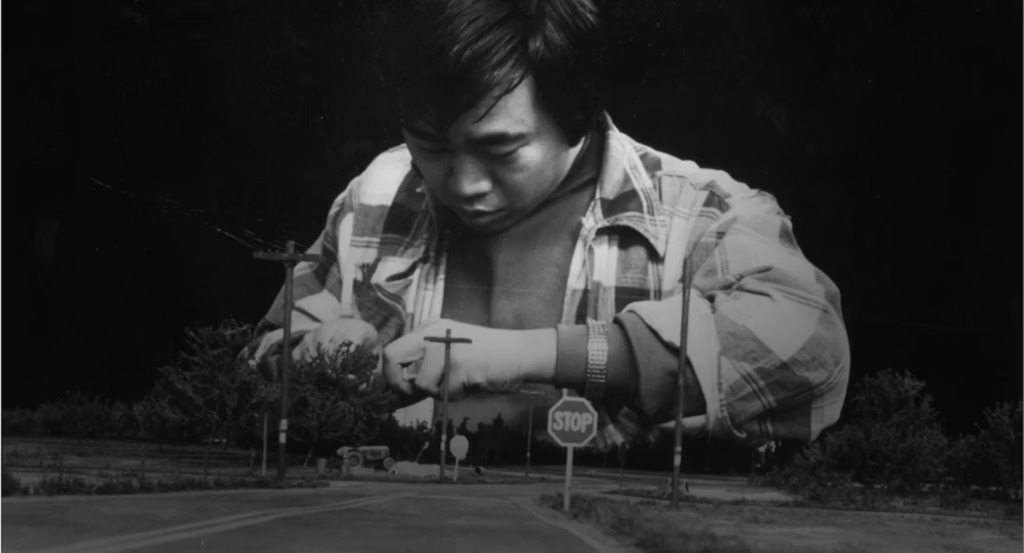
Jein’s collection of screen-used props and models was the stuff of legend.
Jein’s generosity gave Long hands-on access to original Star Trek pieces. He could photograph, measure, and document them thoroughly, which allowed him to produce licensed replicas with near-perfect accuracy.
After Jein’s passing, many of those original screen-used items ended up at auction. In a twist straight out of a Trek script, they found their way back to John Long — this time as a restoration expert.
Long was entrusted with restoring Captain Kirk’s hero phaser and one of the hero communicators. These weren’t background pieces; they were the “go-to” props used in episode after episode, including memorable appearances in stories like “Cloud Minders”, “Gamesters of Triskelion”, “Catspaw”, and “Day of the Dove”.
When Long first saw the communicator that had meant so much to him as a kid, it was basically a hollow shell – missing key parts, including control knobs, the stopwatch mechanism, and the layered Moire pattern that gave it that magical animated “spin.”
He restored it the only way he knew how:
- Using period-correct materials and techniques
- Sacrificing one of his last original 1960s Edmund Scientific Moire sets
- Installing a vintage mechanical stopwatch, just as Wah Chang had done
- Avoiding over-restoration, so that the prop kept its history and authenticity
The result? At auction, Kirk’s phaser sold for around $910,000, and the communicator reached roughly $780,000. Together, those two pieces of TV history brought in close to two million dollars.

Long laughs about it now, but he was prepared to tell the auction house the props were fakes – he’s seen plenty of counterfeits:
“I can’t tell you how many counterfeits and forgeries people have brought to me… sometimes I have to tell them, ‘That’s pretty cool and everything, but I made that 25 years ago.’”
This time, though, he knew exactly what he was holding. They were the real thing – the very props that had inspired his own career.
Faith, Fandom, and the Circle of Props
For Long, all of this – the friendships, the career, the chance to restore legendary pieces – isn’t just random luck. He sees God’s fingerprints in it:
“This is a God thing. This is how God works in our lives. And this is our Father. He knows what his kids like. And sometimes it’s Star Trek. Sometimes it’s Westerns. Sometimes it’s a horse, a real horse… God is generous. He’s got a great sense of humor.”
What started as a kid sanding balsa wood while staring at a grainy still from “Catspaw” turned into a life spent sculpting for Walt Disney Imagineering, building studio-grade props, and rescuing the very items that fired his imagination decades earlier.
In a way, Star Trek’s props have their own circle of life: designed by masters like Wah Chang and Matt Jefferies, used on set by actors like William Shatner, saved and shared by collectors like Greg Jein, and finally restored and reproduced by fans-turned-artists like John Long.
From Fan Letters to a Lasting Legacy
Tron reminds listeners of one of Star Trek’s most famous behind-the-scenes stories: the fans saved the show. After early seasons, NBC considered pulling the plug. Fans launched a massive letter-writing campaign, and those letters helped keep the Enterprise flying long enough to reach its third season.
Decades later, the legacy looks like:
- Technology – Flip phones, tablets, voice-controlled computers, and medical scanners all trace a line back to the original series.
- Storytelling – The show blended adventure with moral questions about war, prejudice, power, sacrifice, and what it means to be human.
- Community – From 1960s fan clubs and fanzines to online groups and conventions today, the Trek community has been connecting people across generations.
- Artisans and Craftsmen – Prop makers, model builders, and designers still study and recreate the show’s gear, keeping those crafts alive.
It all started with one studio willing to roll the dice, one redheaded TV icon willing to fight for the show, one creator with a vision of a better future, and a small army of artists and craftspeople behind the scenes.
Listen to the Conversation
This post is just a taste of the stories Tron Simpson talked about with the Captain and John Long. To hear them tell these tales in their own words – and to hear William Shatner talk about Star Trek, music, and staying young – listen to the full Legends Radio special on air and here after December 21st!
“Happy 60th, Star Trek” – and What Comes Next
As Tron signs off in the broadcast, this isn’t just an anniversary for a TV show. It’s a celebration of:
- The courage of creators like Lucille Ball and Gene Roddenberry
- The craftsmanship of people like Wah Ming Chang, Matt Jefferies, Greg Jein, and John Long
- The curiosity and loyalty of fans who kept the Enterprise flying
Sixty years later, the original series still inspires artists, engineers, writers, and dreamers. Whether you first saw it in the ’60s or on streaming platforms yesterday, you’re part of that ongoing story!
Happy 60th anniversary to Star Trek: The Original Series – and here’s to the next boldly-going generation.
Live Long and Prosper